Sunday, 27 June 2021

Thoughts on Paris


Thoughts on Paris                                                                  


Since there wasn’t much information on historical significance of La Defense, I decided to research a bit on my own. Considered one of the most important financial districts in the world (as it is the business centre of Paris), La Defense was specifically planned to accommodate tall skyscrapers. Though limited at a cap of 100 meters and hit by the impact of economic recession in 90s, the district experienced a revival in the new millennium. Now, housing major business corporations, it is rightfully dubbed as the largest purpose-built business district in Europe.


A distinct feature of this project is the fact that the location of the site was a new one. This is similar to my megaproject as even Navi Mumbai’s site was chosen as the aim was to accommodate residents and business districts without creating the smallest effect on the existing community. Another feature was creating an all-powerful governmental body (in this case, Établissement Public l’Aménagement de La Défense), which would be responsible for land acquisition, development of public facilities, promotion of the megaproject. This feature has been adopted by several countries around the world such as India (Navi Mumbai) and China.

Built at the height of Modernism, the Center of New Industries and Technologies, not only served as a symbol of the new modern Paris, the French government was looking for but also was much appreciate among architecture circles for its use of reinforced concrete in an innovative double shelled design with internal ribs. We can also see that specific features such as ring road/boulevard/motorway/other extension of horizontal axis which would be built in the centre of business district get repeated in all the megaprojects we have studied so far.

Each megaproject would require a symbol; a piece of architecture which would make it stand apart from the rest. For La Defense, it is 110m tall Grande Arche. Modernization of old buildings is a phase which I believe should be implemented in other megaprojects we studied in class (Barcelona). Though there have claims of sustainability as a major part of their vision for La Defense in the future, I didn’t come across anything significant. Yet, the infrastructure principles which have been used for the development of La Defense are a must for any aspiring urban planner and have to be integrated into other megaprojects.


                                                         La Defense (Image Credits: Great Runs)


Sunday, 20 June 2021

Impact of COVID-19 Pandemic on US Infrastructure- Part 6

Impact of COVID-19 Pandemic on US Infrastructure- Part 6


The COVID-19 pandemic has changed the world and society in countless number of ways. Fundamentally, people have realized that we all live in a highly interconnected, globalized world where even a small incident has a ripple effect around the globe. Though it is difficult to look at a silver lining from this, there can be lessons learnt from the pandemic which can be applied for the near future. These two years (2020-21) have presented a crucial moment for the future of American infrastructure. In a way, this is a chance for DOTs, planning boards and other civil engineering organizations to implement comprehensive systematic change, examine the deficiencies of the existing infrastructure and look for ways on how to update it.

“Infrastructure investment decisions made now will affect how we respond to challenges such as climate change, building inclusive societies, and delivering strong, sustainable, and balanced growth. This note raises issues for consideration, in support of infrastructure investment through building longer-term resilience to future shocks, risks, and threats, and aligning investment with infrastructure that can be robust but also innovative and adaptable to changing circumstances and complexities” (OECD). 

OECD Logo (Image Credits: OECD)


Sunday, 25 April 2021

Facebook Rapid Deployment Data Centre

 Facebook Rapid Deployment Data Centre


This blog has mostly covered public projects, funded by the government. Sometimes, you do not need governmental participation to create infrastructure of a certain kind. Sometimes, even a private company can bring in economic investments into a region. One such project which was announced with great fanfare but little has been heard ever since then is the Facebook Rapid Deployment Data Center in Sweden. 
This data centre would have been considered to be the most efficient data processing centre in the world then. “The Facebook Rapid Deployment Data Center, in the town of Luleå in Sweden, takes a modular approach to design and construction to accelerate the speed of assembly. Paying homage to another great Swedish institution, IKEA, Facebook claims that the centres can be built and deployed twice as fast as comparable facilities. The northern location also takes advantage of the surrounding Arctic temperatures to achieve a 100 percent renewable energy-powered cooling system” (KPMG). The centre also been designed in such a way that the servers draw in more air and are more space-efficient as well.
Though the project was announced in 2014, there has been very little information on the status of it since then. It is said that construction has started on the project. 

A picture of the proposed center from the official Facebook presentation (Image Credits: TheNextWeb)


Tuesday, 20 April 2021

Indiana Convention Center expansion

Indiana Convention Center expansion


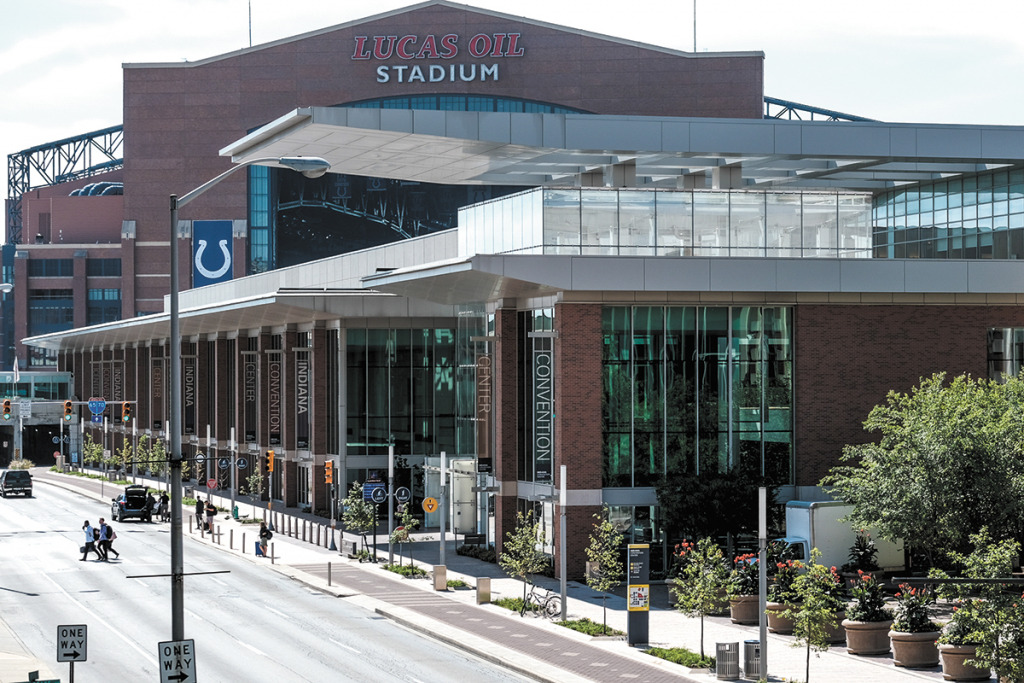
As said before, this blog covers infrastructure projects of every kind, Sometimes, they can even be private, commercial projects which can serve the public community. The Indiana Convention Center is a good example of a centre which has brought in tourists from other states while serving as a congregating point for the locals. But, now the time has come for its expansion.

“The Indianapolis City-County Council will seek support for up to $155 million in bonds for an expansion project related to the Indiana Convention Center…the expansion plan calls for construction of a 50,000-square-foot ballroom across the street from the current convention center. A walkway will be built to connect the new facility to the convention center. Construction will include 93,500 square feet of space for meeting rooms and other uses. City leaders plan for the project to be completed by 2024” (Americaninfrastructuremag).

While there might be questions asked on whether such a project is needed in these COVID-19 times, the leadership might be appreciated for taking such a bold move. This is seen as an investment for the future. 


A picture of the existing convention center (Image Credits: IBJ)


Sunday, 11 April 2021

Kissimmee Accelerated Gravity Sewer Assessment and Rehabilitation Project

 Kissimmee Accelerated Gravity Sewer Assessment and Rehabilitation Project


Infrastructure projects are not just major construction and transportation projects. They can also be environmental rehabilitation projects as well. Last year, a 40 million Water Infrastructure Finance and Innovation Act (WIFIA) loan was granted from the U.S. Environmental Protection Agency (EPA)  to the Toho Water Authority in Kissimmee, Florida. This was done to reduce the possibility of emergency failures and find better ways to reduce environmental impacts associated with wastewater collection system as well as update the outdated infrastructure. So, as one can see, this is a project clearly initiated to develop water infrastructure. 

“Construction and operation phases of the project are expected to create 198 jobs. EPA said that the enhancements are expected to benefit 300,000 people by increasing the treatment capacity and allowing community growth without expanding the current wastewater treatment facility” (NSEnergyBusiness). 


A picture of the existing project (Image Credits: EPA)


Sunday, 28 March 2021

Impact of COVID-19 Pandemic on US Infrastructure- Part 5

Impact of COVID-19 Pandemic on US Infrastructure- Part 5

It has been just over a year since the COVID-19 pandemic hit American shores in every way possible. Just like other industries, US infrastructure also has been damaged as covered by previous articles in this blog. It goes without saying that there would be deficits in revenue, major projects’ progress being halted or cancelled completely as well as struggles in approving budgets for new projects.

So what are some possible solutions for this? “DFIs can, for example, assist governments in diagnosing risks early to mitigate the virus’ impacts on project portfolios through expert support, training, and tools. Projects in pipeline should be re-reviewed often in this changing environment and projects under construction or in operation should be reexamined for any contractual remedies available to mitigate the effect of potential delay and funding needs. Where governments lack the expertise and resources to take this on, DFIs can step in to help” (Worldbank).


An infographic showing the impact of the virus on the construction and infrastructure markets (Image Credits: Businesswire)


Sunday, 21 March 2021

Honolulu Rail Transit

Honolulu Rail Transit


Honolulu has been slowly growing as an important city which would need a rail transit system for its own. For a long time, there has been a debate on whether such a network is required and if so, would it be a light rail system or a heavy system. Anyways, a 20-mile system with 21 stations for $5.2 billion was announced in 2012. 

“But by this past fall Honolulu Mayor Kirk Caldwell was projecting the rail line will not be done until 2033, and will cost an astonishing $11 billion...that marks the third time since 2012 the city has announced huge rail cost overruns, and this budget shortfall may be more difficult to resolve than the previous two. A key lawmaker says it will be “too difficult” for the state to step in for a third time with a financial bailout for the city rail project” (Civilbeat).

The project definitely has its share of benefits as it would be a big uplift for the economic development of the region? But at what cost? This blog would continue to cover this project in the upcoming months. 


A picture of the rail network (Image Credits: Civilbeat)